Enjoy FREE shipping on your first order! (Minimum $99 purchase)
Alert: Important Update for US patients - Upcoming U.S. Government changes. Click to read more
Enjoy FREE shipping on your first order! (Minimum $99 purchase)
Alert: Important Update for US patients - Upcoming U.S. Government changes. Click to read more
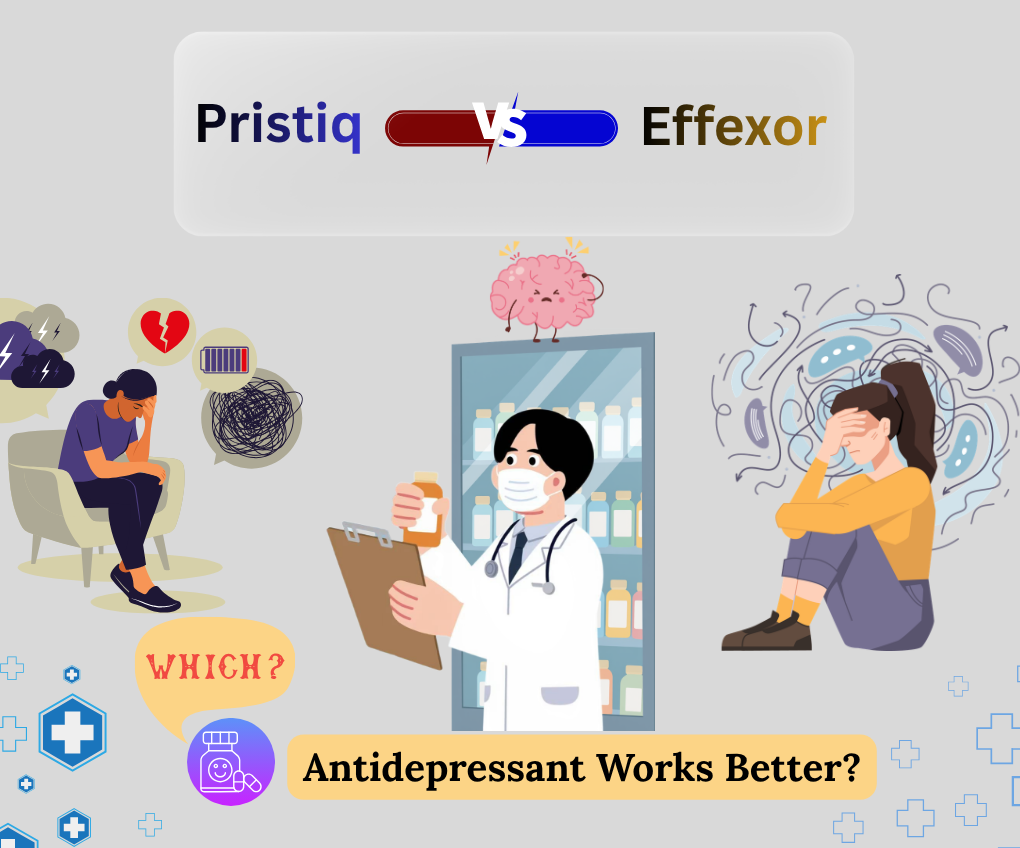
Pristiq and Effexor are two commonly prescribed serotonin-norepinephrine reuptake inhibitors (SNRIs) used to treat depression and certain anxiety disorders. Because they belong to the same medication class and work in similar ways, many patients wonder which option may be more effective.
In a nutshell, neither drug is inherently "better." The most appropriate choice depends on factors such as your symptoms, medical history, tolerance to side effects, and how your body reacts to previous treatments. Despite their many similarities, Pristiq and Effexor differ significantly in dosage, side effects, withdrawal symptoms, and cost, which may affect treatment choices. Readers interested in learning more about Pristiq, including its uses, dosage, side effects, and safety information, can read our detailed Pristiq (Desvenlafaxine) Guide.
Pristiq and Effexor are closely related antidepressants that belong to the serotonin-norepinephrine reuptake inhibitor (SNRI) class. Both work by increasing serotonin and norepinephrine levels in the brain, but they differ in several important ways:
When comparing Pristiq or Effexor for depression, both medications are regarded as effective treatments for major depressive disorder (MDD). The effectiveness of one antidepressant over another in treating depression has not consistently been demonstrated by research.
Both medications may help improve symptoms like:
Individual response is typically what makes the difference. While Effexor provides more symptom relief for some patients, Pristiq works better for others.
Effexor may have an advantage when anxiety is also a significant worry. It is FDA-approved for some anxiety-related disorders, such as panic disorder, social anxiety disorder, and generalized anxiety disorder. Because of these approved indications, healthcare providers may consider Effexor when anxiety symptoms play a major role in a patient's condition.
However, it does not imply that Pristiq cannot help those who suffer from both depression and anxiety. Although anxiety is not the main FDA-approved reason for Pristiq, many individuals experience improvements in both mood and anxiety symptoms while using the medication.
Like all antidepressants, both Pristiq and Effexor may have adverse effects.
Since both medications function similarly, many side effects overlap. Common side effects include:
One important consideration is blood pressure. Both Pristiq and Effexor have the potential to raise blood pressure in some patients, especially at higher doses. Healthcare providers may recommend periodic blood pressure monitoring during treatment.
Pristiq is often prescribed at a standard daily dose, while Effexor may require more gradual dose adjustments. Some patients find Pristiq's dosing schedule simpler, although individual experiences vary.
Experiences with side effects are highly individual. One person may tolerate a medicine well, while another may experience unpleasant side effects.
Withdrawal symptoms are frequently one of the main concerns when comparing Pristiq and Effexor. Abruptly stopping either medication can result in antidepressant discontinuation syndrome, which can lead to:
Of the two medications, Effexor is generally linked to a greater chance of experiencing higher risk of withdrawal symptoms. This is mostly because the medication leaves the body faster due to its comparatively short half-life.
Withdrawal from Pristiq can also happen; it is crucial to see a healthcare expert before abruptly stopping treatment, regardless of the medicine being utilized. For a detailed overview of symptoms, duration, and management strategies, read our guide on Pristiq Withdrawal Symptoms.
One advantage of Pristiq is its simple dosing schedule, and for most adults, the recommended dose is 50 mg once daily, which is typically the starting dose, and if tolerated well, the same is followed as the maintenance dose. Although higher doses may sometimes be prescribed, they have not consistently been shown to provide additional benefit for most patients.
Effexor dosage is typically more adaptable. It is advised to begin an Initial dose with 37.5 to 75 mg per day, and then, depending on response, the dose may be gradually increased.
The availability of generic versions has made both medications more affordable for many patients. Actual costs vary depending on factors such as insurance coverage, pharmacy pricing, dosage strength, and location.
Generic venlafaxine (Effexor) is frequently less expensive than generic desvenlafaxine (Pristiq). Although the difference is modest.
Pristiq is preferred by patients who want a simple dosing schedule, whereas some medical professionals prefer the dosing flexibility of Effexor while tailoring individual treatment plans.
Looking for affordable Pristiq or Effexor? Canada Pharmacy Pro offers convenient online ordering and access to prescription medications for eligible patients with a valid prescription.
Both Pristiq and Effexor are effective SNRIs with proven uses in the treatment of depression. The choice between two depends on factors such as anxiety symptoms, side effect tolerance, withdrawal worries, dosage preferences, and individual response to treatment
Pristiq provides a simpler dosing method that many patients find convenient, although Effexor has additional FDA-approved indications for anxiety. Neither medication is inherently better than the other.
The most appropriate option is the one that suits your overall treatment plan and offers significant symptom alleviation with tolerable side effects. A healthcare provider can help determine which medication best fits your individual needs, medical history, and treatment goals.
Effexor contains venlafaxine, whereas Pristiq contains desvenlafaxine. Both belong to the SNRI class of antidepressants. Effexor has additional FDA-approved applications for several anxiety disorders and typically provides a broader dosing range.
Not necessarily. Both medications are effective treatments for depressive disorder. Individual responses differ, and depending on the patient, one medicine may be more effective than another.
Both have similar side effects, but some patients find Pristiq slightly easier to tolerate due to its simpler dosing. Although experience depends person to person.
Both medications can result in withdrawal symptoms if discontinued suddenly. However, Effexor is frequently associated with a higher risk of discontinuation symptoms, because of its shorter half-life
Effexor has FDA approval for several anxiety-related disorders, including generalized anxiety disorder, social anxiety disorder, and panic disorder. Although anxiety disorders are not among Pristiq's FDA-approved indications, some patients may experience improvements in anxiety symptoms while taking it.
Yes, Generic desvenlafaxine (Pristiq) is slightly a little more expensive than generic venlafaxine (Effexor), although costs may vary based on factors like strength, dosage, pharmacy pricing, and insurance coverage.
Your symptoms, treatment objectives, medical history, and drug tolerance will determine which option is best for you. A healthcare provider can help determine which medication is most appropriate for your individual needs.
Some patients may switch between Pristiq and Effexor under the guidance of a healthcare provider. Because both medications affect serotonin and norepinephrine levels, dosage adjustments and careful monitoring may be required during the transition.
> Allergy Medications: Types, Uses, Costs & Side Effects
> Xeljanz Cost & Savings Guide: How to Buy Safely Online
> 5 Ways to Lower Your Prescription Drug Prices This Month