Enjoy FREE shipping on your first order! (Minimum $99 purchase)
Alert: Important Update for US patients - Upcoming U.S. Government changes. Click to read more

Enjoy FREE shipping on your first order! (Minimum $99 purchase)
Alert: Important Update for US patients - Upcoming U.S. Government changes. Click to read more
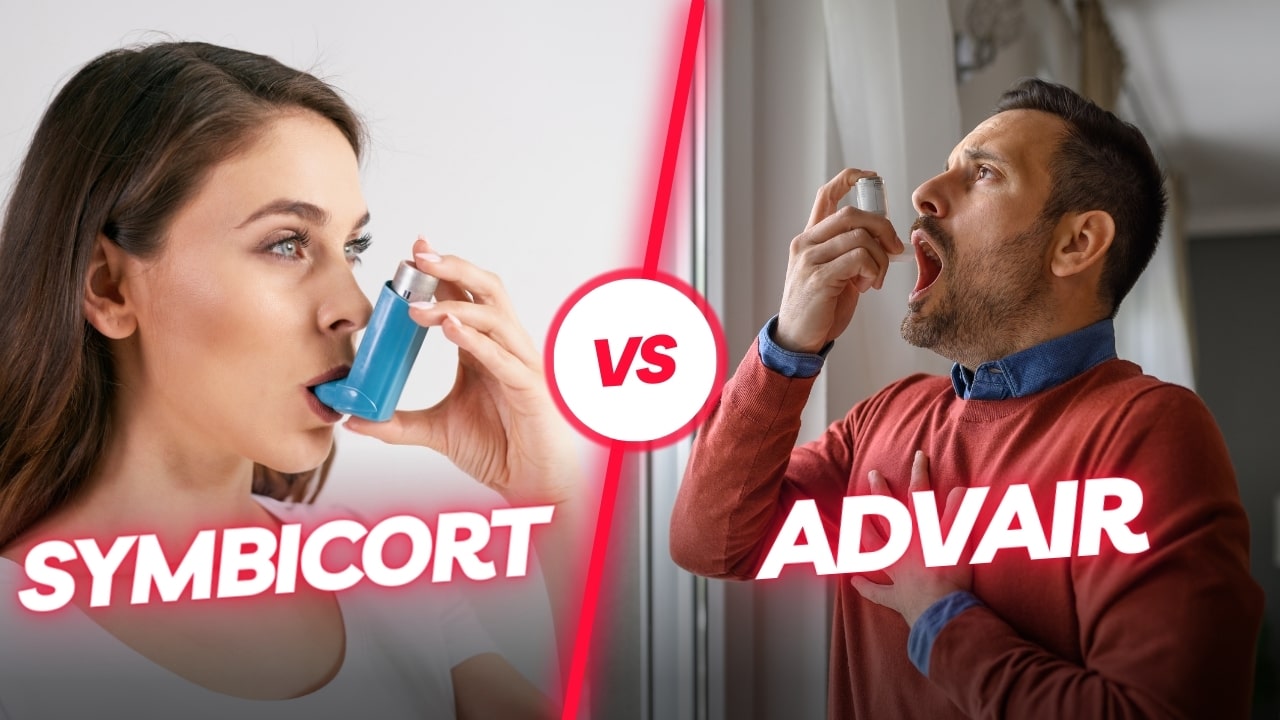
Combination drugs such as Advair and Symbicort are used to treat asthma and chronic obstructive pulmonary disease (COPD). Both of these medications relatively work to help manage symptoms related to asthma and COPD. However, both drugs have different mechanisms of action because of different active ingredients.
We have tried to relate the better understanding of Symbicort vs Advair; and their similarity, benefits, and differences of both the medications.
Symbicort is a combination drug that contains two active ingredients i.e. Budesonide and Formoterol. A corticosteroid called budesonide acts by decreasing airway inflammation. It reduces the infiltration of inflammatory cells into the tissues of the airways and suppresses the release of inflammatory mediators.
One long-acting beta2-agonist (LABA) bronchodilator is formoterol. It functions by causing the smooth muscles in the airways to relax, which opens them up and facilitates breathing. Bronchospasm is permanently relieved by formoterol.
However, Advair contains two active components salmeterol and fluticasone propionate. Like budesonide in Symbicort, fluticasone propionate is a corticosteroid that also decreases inflammation in the airways. salmeterol is another LABA bronchodilator. It functions by causing the smooth muscles in the airways to relax, which improves airflow and bronchodilators.
In conclusion, a corticosteroid to lower inflammation and a LABA bronchodilator to calm the airway muscles are present in both Symbicort and Advair. Together, they have anti-inflammatory and bronchodilatory properties that help control the symptoms of asthma and COPD.

Both Advair and Symbicort are combination drugs used to treat asthma and chronic obstructive pulmonary disease (COPD), yet their usage and indications may differ slightly:
Symbicort is majorly used for the maintenance treatment of asthma. It can be prescribed to patients six years of age and older. It is used to manage asthma symptoms and keep patients from having asthma attacks, or exacerbations when they need to take long-acting beta2-agonists (LABAs) and inhaled corticosteroids regularly. Symbicort is also authorized for the long-term maintenance treatment of emphysema and chronic bronchitis associated with airflow obstruction in patients with COPD.
Whereas, Advair is also prescribed for the long-term maintenance treatment of asthma. Advair is prescribed for patients 4 years of age and older. It is used to manage asthma symptoms and keep patients from having asthma attacks, or exacerbations when they need to take long-acting beta2-agonists (LABAs) and inhaled corticosteroids regularly. Advair is also authorized for the long-term maintenance treatment of emphysema and chronic bronchitis associated with airflow obstruction in patients with COPD.
The severity of the ailment being treated, the patient's age, and other distinctive factors can all affect the dosage of Advair and Symbicort. For asthma, it is advised to begin with two twice-daily inhalations of either Symbicort 80/4.5 or Symbicort 160/4.5. For children aged six to eleven, two Symbicort 80/4.5 inhalations twice daily are the recommended starting dose. The suggested dosage for COPD is two Symbicort 160/4.5 inhalations twice a day.
However, Advair when administered in adults and adolescents for asthma is recommended as one inhalation of Advair Diskus 100/50, 250/50, or 500/50 twice a day is the recommended dosage. For children (4 to 11 years old), one inhalation of Advair Diskus 100/50 twice a day is the recommended dosage. For COPD the recommended dosage is 1 inhalation of Advair Diskus 250/50 twice daily.

Although their modes of action and benefits are similar, their adverse effect profiles could differ slightly.
The following are typical Symbicort adverse effects:
Advair side effects that are common include:
Both Symbicort and Advair come with warnings about the possibility of major adverse effects in addition to these typical ones:
Both Advair and Symbicort may interact with other drugs, decreasing their efficacy or raising the possibility of adverse effects.
Some common drug interactions with Symbicort are:
Similarly, Advair also has certain drug interactions, some of which include:

When it comes to buying Symbicort or Advair, people compare Symbicort Vs Advair on their effectiveness; they also seek potential differences in Symbicort Vs Advair cost. On average the Symbicort VS Advair cost is quite comparable. The average Symbicort Inhaler cost is $ 550- $600 for a 10.2GM of 160-4.5 MCG/ACT inhaler. However, the Advair HFA cost(115mcg-21mcg) in a strength of 8 Gms cost roughly around $200.
Symbicort and Advair are used to treat asthma and COPD symptoms patients opt for the better one based on their conditions, doctors' recommendations, fewer side effects, and good price. One can and from CanadaPharmacyPro.
Symbicort is a brand-prescribed medication used for asthma and COPD. In the US, there are few generic equivalent versions of Symbicort available recently. However, their availability in the market can vary based on national policy and other factors. Symbicort has high demand and a low supply chain due to its effectiveness. It is a combination drug of two active ingredients contributing to high Symbicort cost.
However, the scenario concerning Advair has changed historically, the combination of two active ingredients (fluticasone propionate and salmeterol) and the difficulty of replicating its unique delivery system have made it difficult for generic versions of Advair to receive approval and reach the market. Nonetheless, is available now. Symbicort and Advair brand and generic medication can be easily obtained from CanadaPharmacyPro.

The individual's unique condition, medical history, and reaction to treatment are some of the criteria that determine which medication—Symbicort or Advair—is safer or more effective. While Advair and Symbicort work well to reduce the symptoms of asthma and COPD, their safety and efficacy profiles may vary depending on the patient.
According to clinical research, Symbicort and Advair help asthmatic patients breathe easier, feel less symptomatic and avoid exacerbations. Variables like the severity of asthma, past treatment outcomes, and personal preferences may influence the decision between the two. Likewise, Symbicort and Advair have proven effective in enhancing lung function, mitigating symptoms, and averting exacerbations in those suffering from COPD.
There is a warning on both prescriptions regarding the possibility of asthma-related deaths and exacerbations, especially if an inhaled corticosteroid is not used along with the long-acting beta agonist. Due to variations in pharmacokinetics, tolerability, or other factors, some people may respond better to one medicine than another.
In the end, selecting between Advair and Symbicort should be done after consulting a healthcare professional who can evaluate the patient's unique needs, medical background, and desired course of treatment. They can assist in balancing the possible advantages and disadvantages of each drug and adjusting the treatment plan as necessary to maximize results and reduce adverse effects.
There are lots of myths around Symbicort vs Advair and their administration together. Generally speaking, using Symbicort and Advair together is not advised without particular advice from a healthcare professional. Combining them may raise the chance of adverse effects, such as those brought on by beta-agonists and corticosteroids. Combining two combination inhalers can result in an overdose of the active chemicals, which can have detrimental effects on the heart and induce tremors, elevated heart rate, and possibly even major cardiovascular problems.
Both Advair and Symbicort are combination inhalers that are used to treat asthma and chronic obstructive pulmonary disease (COPD). They have a long-acting beta-agonist to help expand airways and a corticosteroid to decrease inflammation. However, because they have distinct active components, they are not regarded as interchangeable. While both medications work similarly to control symptoms and prevent exacerbations, individual responses to medications can vary. Some people may find one medication more effective or the other way.
The Symbicort cost varies depending on the country in which you are, whether you have insurance, the precise formulation, the dosage that is prescribed, and the availability of a generic version. Symbicort is a combination drug that includes formoterol, a long-acting beta-agonist, and budesonide, a corticosteroid. Combination medicine formulation and production might be more expensive and complicated. One can at a reduced price from CanadaPharmacyPro.
Albuterol can be taken safely and quickly after using Advair, but as always, make sure to follow the directions on your prescription label as well as the advice from your healthcare professional. When an asthma attack or flare-up occurs, albuterol opens airways quickly to help to breathe, but Advair works overtime to reduce inflammation and prevent symptoms, giving long-term control. It is usually advised to wait a few minutes between doses if you need to take albuterol soon after taking Advair.
When used as directed regularly, Advair and Symbicort can help avoid asthma flare-ups, commonly referred to as exacerbations. Albuterol and other quick-relief drugs, however, are usually administered during a flare-up to open airways and offer relief quickly.
> Allergy Medications: Types, Uses, Costs & Side Effects
> Xeljanz Cost & Savings Guide: How to Buy Safely Online
> 5 Ways to Lower Your Prescription Drug Prices This Month